Structure
Timber-frame logic and load-bearing junctions are chosen for the model's volume, layout and loads. It is the base that every other layer rests on.
Frame spacing, junction types and load scheme are clarified at package and project level.
In frame and modular houses, the exterior is only one part of the decision. The logic of the layers matters just as much: structure, insulation, wind protection, exterior finish and technical readiness must fit the use case and climate. The exact assemblies are confirmed in the written offer.
A beautiful exterior is only the beginning. Trust starts when the structure, materials and package boundaries are clear.

Timber-frame logic and load-bearing junctions are chosen for the model's volume, layout and loads. It is the base that every other layer rests on.
Frame spacing, junction types and load scheme are clarified at package and project level.
Insulation depth and layer logic are shaped by the package level and destination conditions. Seasonal use and year-round use mean different approaches.
Insulation thickness and layer composition are clarified per model and use case in the offer.
Facade and roof solutions are clarified by architectural language, finish and climate. The same model can be calm or more expressive, depending on the choice.
Finish materials, colour tones and roof covering type are confirmed in the offer.
Electricity, water, sewerage and heating logic are clarified per package level and specific site. Some clients want full readiness, others only base connections.
Engineering scope and on-site interfaces are clarified in the project offer.
Insulation, exterior finish and technical readiness are selected according to the use case. A sauna, guest house and year-round home do not need the same solution.


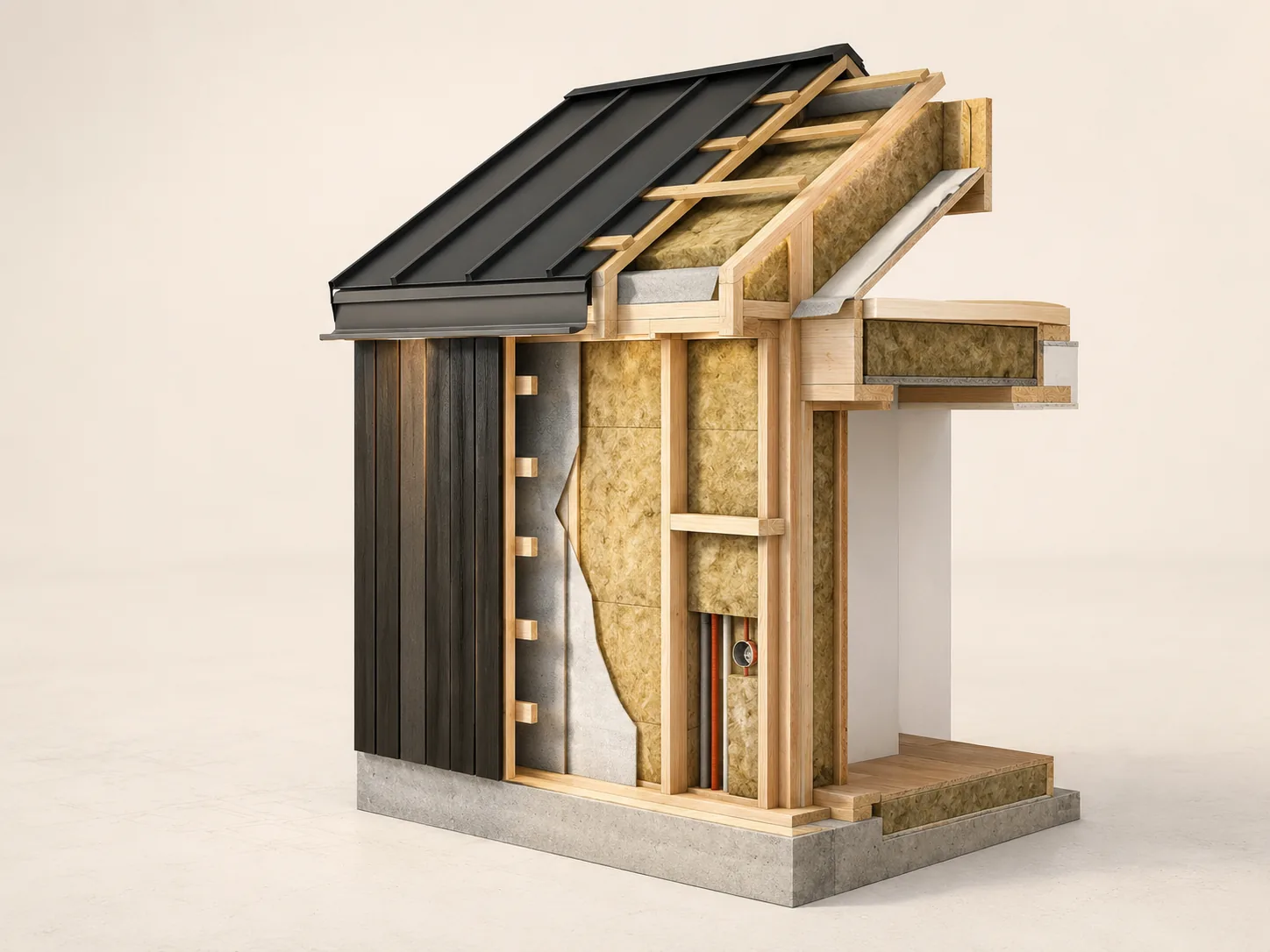
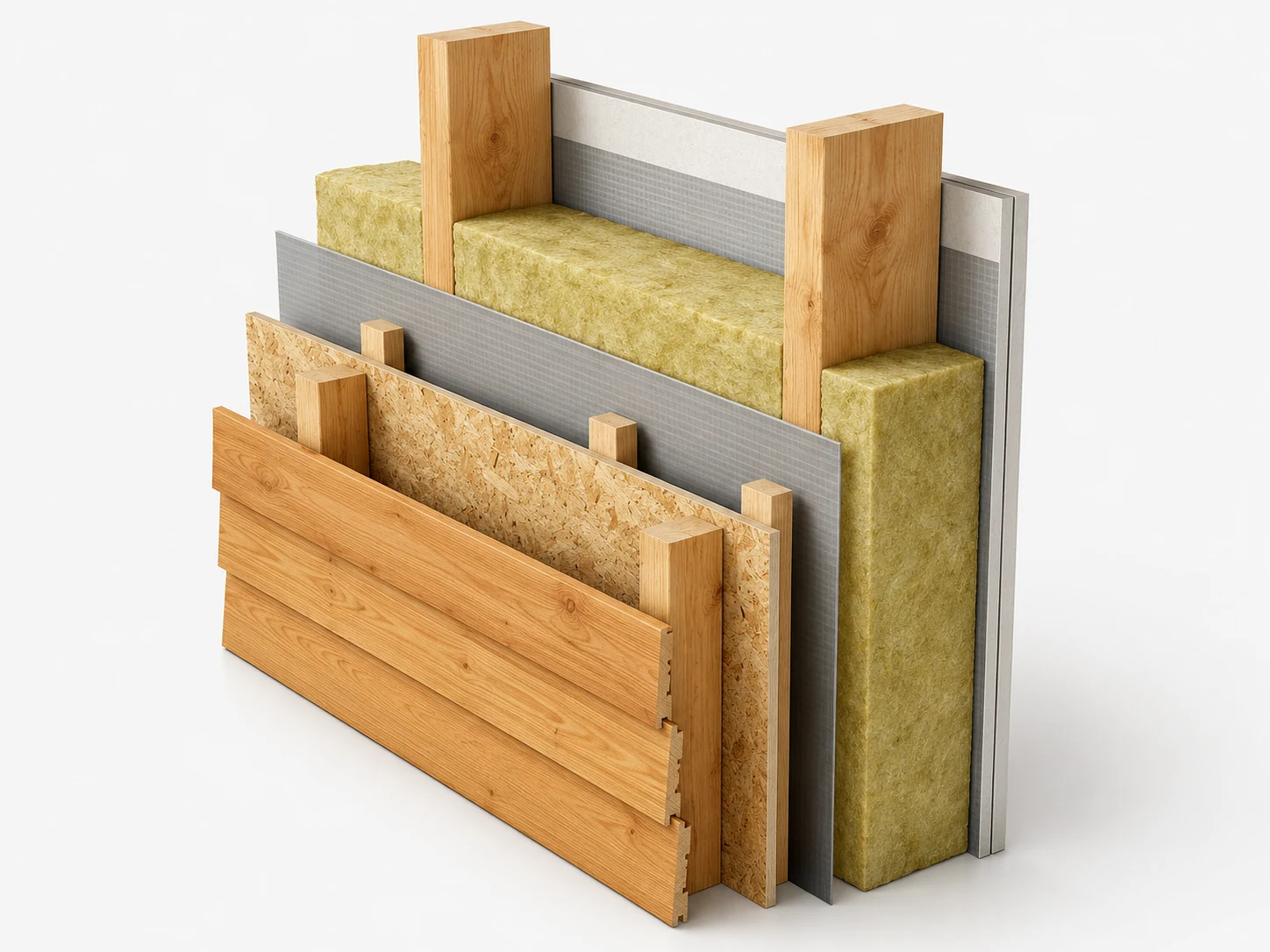
A modular house is easier to understand when you can see how the wall is built up: the load-bearing frame, insulation, protective layers and interior and exterior finish work as one system. The exact layer composition and material brands are confirmed in the written offer for the selected model and package.
Timber frame carries the loads and sets the base for the layers.
Insulation is placed inside the frame cavities according to the package level.
Wind and vapour barriers keep the insulation dry and effective.
The interior surface is shaped by the chosen package and style.
Facade and roof are clarified for architectural language and climate.
Manufacturer technical illustration of the wall-system logic. Specific materials and thicknesses are confirmed in the offer.
Models differ in volume, layout and use logic. Technical choices differ with them.
General descriptions should not be read as exact specifications. The final data is always in the offer for a specific project.
One model does not automatically define the exact specification of every other model. The exact data for a specific project is confirmed in the written offer for that model.
Clients usually see only the facade, windows and floor plan. But comfort is built by layers that normally stay invisible: the load-bearing frame, insulation, wind and moisture barriers, roof, facade, interior finish, engineering outputs and the quality of assembly. Factory preparation helps to keep repeatable processes under control: element geometry, the assembly sequence, material protection and junction quality.
A good result, though, only appears when the structure is tied to the way the house will be used. A year-round home, a guest module and a sauna do not need to follow the same technical logic. That is why we do not sell abstract “technology”.
We tune the technical scope to the model, the climate, the site and the client’s expectations.
Holds geometry, stability and the ability to deliver and assemble the house safely.
Thickness and material must match the season, climate and the expected comfort level.
Wind barrier, vapour barrier and correct junctions help the house work as a system, not as a pile of materials.
A facade should look good but also be clear in maintenance and fit for the climate.
The roof shapes the look, durability, snow loads, water drainage and assembly choices.
Electricity, water, sewage and heating must be tied to the way the house is actually used.
The same house behaves differently on different sites. Soil, slope, water table, access, room for equipment, distance to utilities and local rules all matter. That is why a foundation cannot be promised as a universal line in a price list. Clients often focus on the house while the site feels secondary. In practice, the site decides how easily the house can be delivered, where equipment can stand, which foundation to choose and which works need to be done before assembly.
A good site does not have to be perfectly ready. What matters is being honest about its limits before the house is produced and on its way to you.
Below is the universal technical logic that explains how the models are built. Typical solutions are given as a reference. Specific materials, thicknesses and brands are confirmed in the written offer for the selected model and package.
Kiln-dried structural timber in the load-bearing frame, typical wall section around 45 × 145 mm. The exact strength class is confirmed in the written specification.
Floor joists typically around 45 × 195 mm. Roof beams around 45 × 145 or 45 × 195 mm at roughly 600 mm spacing. Exact dimensions depend on the model.
Stone-wool insulation, for example ROCKWOOL or equivalent; wall thickness typically 150–200 mm. Plus wind and vapour barriers and OSB sheathing (for example 12 mm). Some build-ups add a PIR board. The exact brand and thickness are confirmed in the offer.
Available options include fibre-cement boards, metal siding, PVC siding, treated wood, and ventilated ceramic tile systems. Roofing is typically bitumen roll or standing-seam metal.
Interior surfaces use, for example, moisture-resistant gypsum board (including GKVL), wood lining, wood-panel boards, ceramic tiles and 3D gypsum panels. The solution is selected for style and package.
Windows use energy-saving triple glazing in PVC profiles around 70 mm thick, including laminated variants depending on the model. The entrance door can be metal or glass.
Internal wiring is routed in protective conduit (we use VVG-NG-type cables with non-flammable insulation or equivalent); sections are chosen per project - for example 3 × 1.5 mm² for lighting and 3 × 2.5 mm² for socket circuits. The electrical panel, sockets and switches are included within the package. Water and sewage routes run inside the module, hidden or exposed.
We use a supply-and-exhaust ventilation system with heat recovery: fresh air is delivered to the rooms, stale air is extracted, and most of the heat stays inside the house. The system size and the heating solution are chosen for the model, the package and the use-climate.
Modules are factory-prepared and packed in a protective layer for transport. The installation schedule depends on site readiness, season and logistics; the exact window is confirmed in writing.
These notes are universal. The composition of a specific house (class, brand, thickness, profiles) is fixed in the written offer at model and package level.

One of the most common misunderstandings in construction is the word “turnkey”. For one supplier it means the house kit with assembly. For another it adds interior finishing. For a third it also includes foundation, equipment, utilities, kitchen, furniture and local works. We find it more honest not to argue about the term but to show the composition. What is part of the house, what is part of assembly, what is calculated separately, what can be added and what depends on the site and local contractors. The client then compares real scope, not a promise.

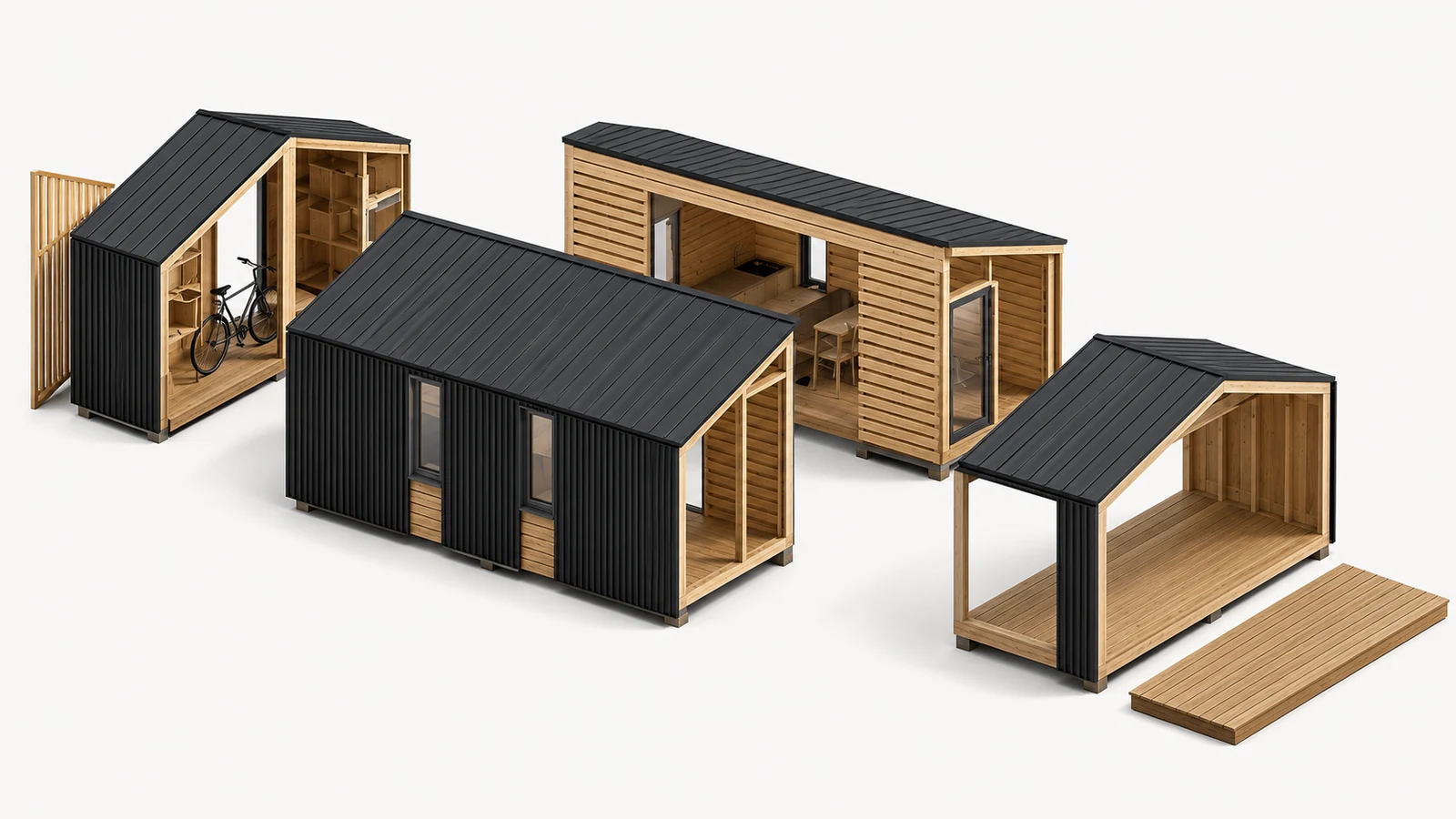
Modular construction means the house is planned as a system of factory-prepared blocks, not as improvised on-site work. Models can be read as a prepared building logic that can be combined or adapted depending on the model, transport limits, site access and the selected package.
Manufacturer concept visual of the modular-system logic - not a photo of a delivered project.
Modules are completed in controlled conditions before reaching the site.
The same model can grow or shift when the project allows it.
Materials, finish and package boundaries are confirmed in writing.
A well-fitted layer logic means a calm indoor climate in summer and winter.
Clear material choices make long-term maintenance predictable.
Structure and module size affect how the building reaches your site.
Engineering readiness reduces on-site work and surprises.
A good technology-level decision carries forward into years of daily comfort.
5-year warranty according to the written warranty terms. Documents and certificates are available on request or confirmed in the offer.
Send a request with the model and use case. In the offer we describe the technical choices that fit your project.